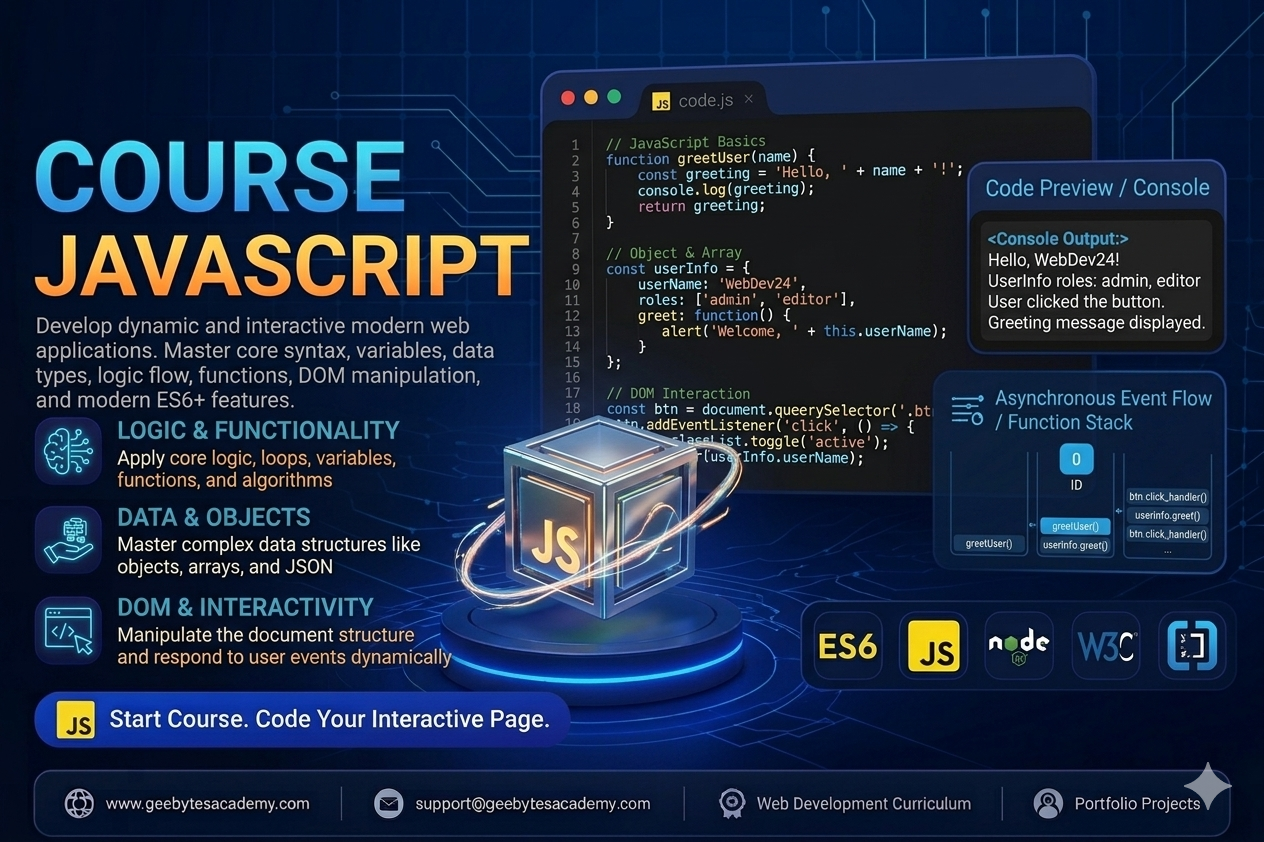
Course Overview
Level: Beginner to Intermediate
Prerequisites: Good understanding of HTML structure and CSS core concepts
Goal: Master programming logic, DOM manipulation, object-oriented principles, and modern asynchronous ES6 plus development patterns.
Module 1: JavaScript Foundations and Syntax
Introduction to the Engine: How browsers execute JavaScript code, the role of the VConsole, and developer tools.
Variables and Storage: Declaring variables using var, let, and const, and understanding block scope.
Primitive Data Types: Working with Strings, Numbers, Booleans, Null, Undefined, and Symbols.
Basic Operators: Utilizing arithmetic, assignment, comparison, and logical operators for value computations.
Module 2: Control Flow and Logic
Conditional Statements: Directing application flow using if, else if, else, and ternary operators.
Switch Statements: Managing multi-conditional checking clean structures.
Loops and Iteration: Repeating operations efficiently using for, while, and do-while loops.
Break and Continue: Controlling loop execution states and preventing infinite processing loops.
Module 3: Functions and Execution Context
Declaring Functions: Building reusable blocks using function declarations and function expressions.
Parameters and Return Values: Passing dynamic data into functions and capturing outputs.
Arrow Functions: Writing clean, modern ES6 arrow function shorthand syntax.
Scope and Closures: Understanding global scope, local scope, lexical scope, and data privacy closure techniques.
Module 4: Working with Data Structures: Arrays and Objects
Array Operations: Creating lists and mutating them using push, pop, shift, and unshift.
Advanced Array Methods: Transforming data arrays using map, filter, reduce, forEach, and find.
JavaScript Objects: Building key-value pairs, accessing properties via dot and bracket notation, and defining object methods.
JSON Mechanics: Converting data structures between JavaScript Objects and JSON strings for API readiness.
Module 5: DOM Manipulation and Event Handling
The Document Object Model: How JavaScript targets HTML nodes through the document tree.
Selecting Elements: Using modern querySelector and querySelectorAll API methods.
Modifying Layout Content: Dynamically changing text content, inner HTML, and element attributes.
Styling via JavaScript: Adding, removing, and toggling CSS classes smoothly using classList.
Event Listeners: Responding to user interactions like click, submit, keydown, and scroll events.
Module 6: Object-Oriented JavaScript and ES6 Features
Template Literals: Writing complex string interpolations without concatenation.
Destructuring and Rest Spread: Unpacking values from arrays and objects cleanly.
Classes and Inheritance: Building blueprints using constructor functions, classes, and the extends keyword.
The This Keyword: Mastering execution contexts and binding references accurately.
Module 7: Asynchronous JavaScript and API Integrations
The Event Loop Architecture: Understanding synchronous versus asynchronous execution stacks.
Callbacks and Promises: Managing delayed operations and escaping callback hell.
Async Await Syntax: Writing asynchronous API operations with synchronous readability.
Fetch API: Requesting, processing, and sending data to external third-party web services.
Capstone Portfolio Projects
To graduate from this course, students will build two real-world, highly interactive applications demonstrating programming mastery:
Project 1: An Advanced Interactive Task Management Application
Students will design a functional task management engine. This application allows users to create, read, update, and delete tasks dynamically. It features category filtering, priority sorting, tracking input states via event listeners, and data persistence using Browser LocalStorage so data remains saved on page refresh.
Project 2: A Real-Time Multi-Source Weather Dashboard App
Students will build a dynamic dashboard that connects to a live third-party Weather API. The application will fetch real-time weather metrics based on user location input, handle error responses gracefully for missing cities, parse JSON payloads, and update UI displays instantly with custom animations. This project tests full mastery of asynchronous programming and structural DOM rebuilding patterns.